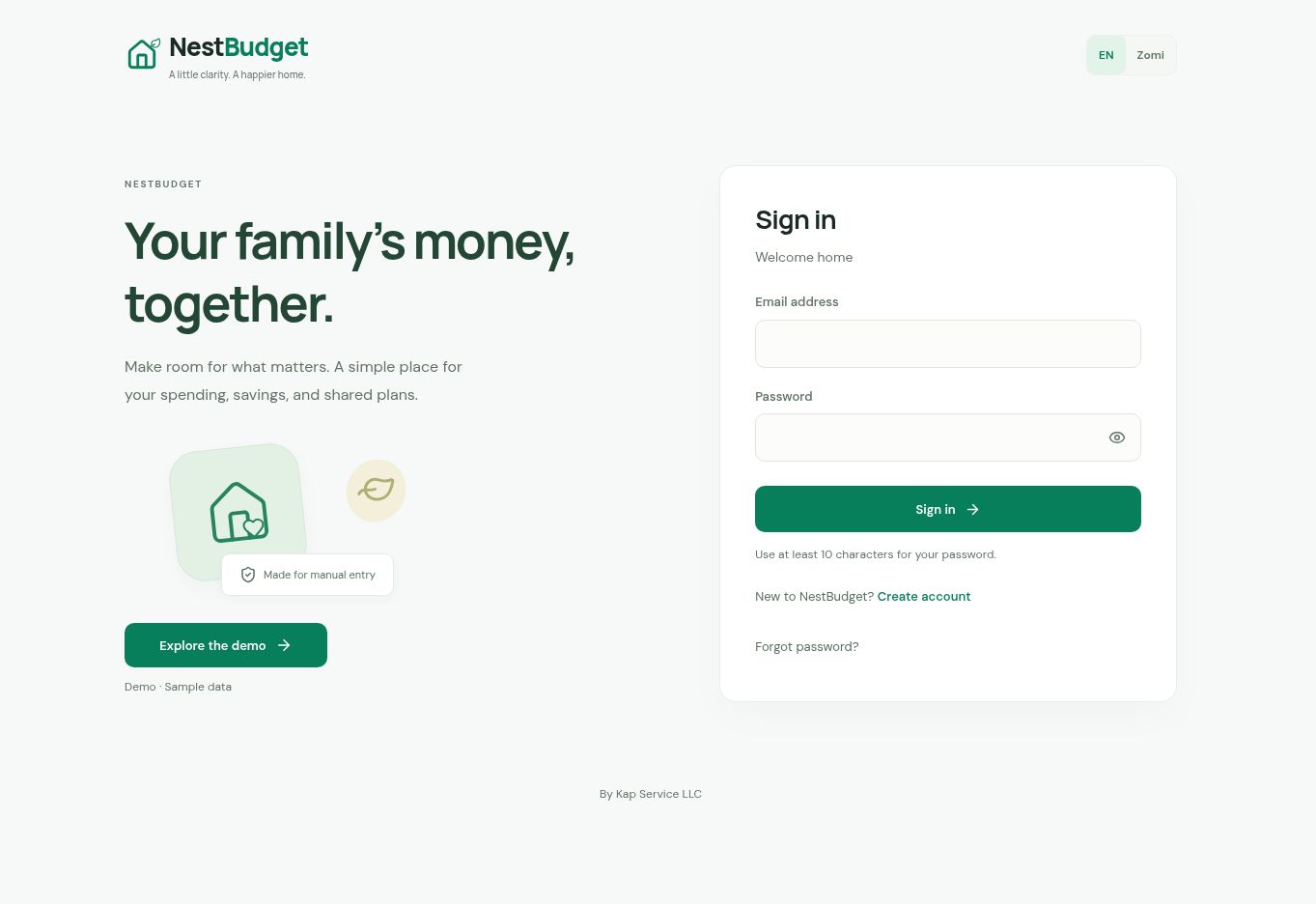
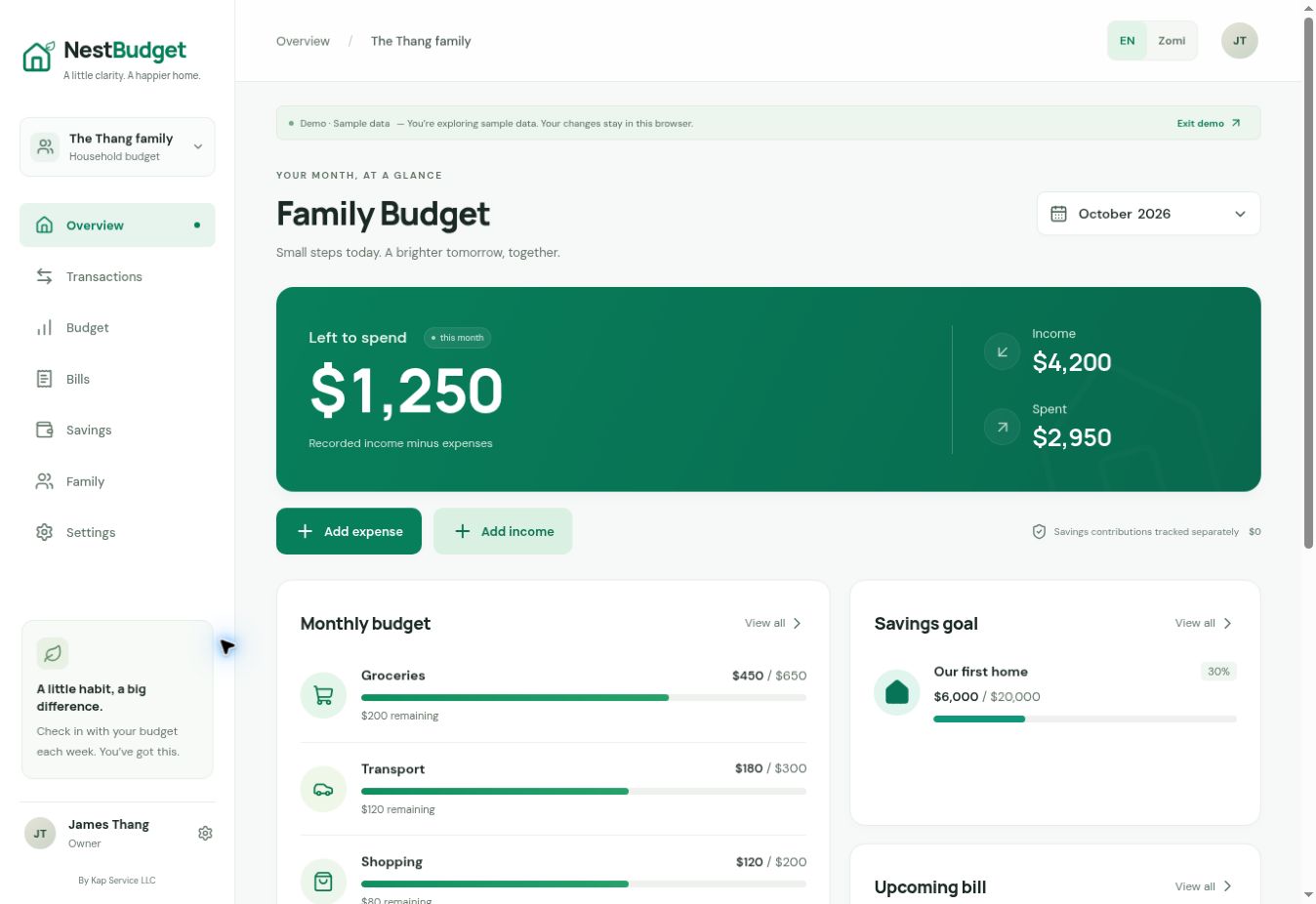
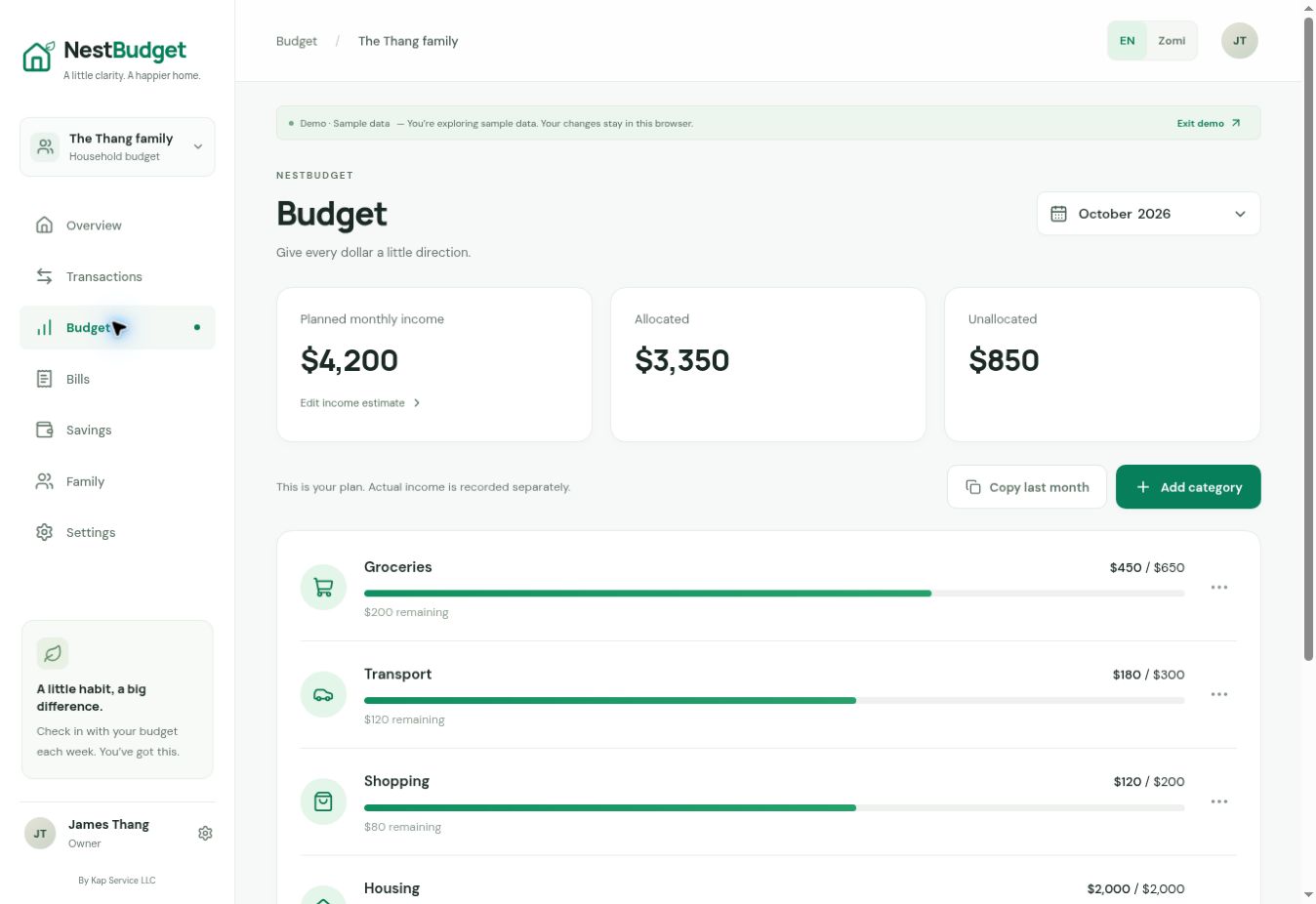
A family budgeting project spanning web and Expo mobile experiences. Transactions, bills, savings goals, and household collaboration bring access rules and financial correctness into the same workflow.
Compare planned income and category spending. Sample data.
01 / SYSTEM VIEW
Where the boundaries sit.
A simplified view to support a technical conversation.
USER EXPERIENCE
Web application
Household budgets and financial workflows
Expo mobile app
Native sign-in and shared financial logic
↓↓
TRUST BOUNDARY
Application backend
Household roles · input validation · version checks
↓↓
Financial state
Transactions, bills, and savings goals
Shared calculations
Integer cents and recurring dates
Conceptual view of the project. The reviewed financial model tests verify defined behaviors; they are not an end-to-end test of mobile synchronization or the deployed API.
02 / ENGINEERING DECISIONS
The reasoning matters.
Implementation choices paired with the tradeoffs they introduce.
01
Represent money in integer cents
The selected tests check exact decimal parsing and reject fractional-cent inputs, negative amounts, and non-finite values.
REVIEW CONSIDERATION
Validation rules depend on the field: a zero budget limit can be valid even when a zero transaction is not.
02
Make repeat actions predictable
The bill model checks for an existing payment before adding another transaction and next occurrence.
REVIEW CONSIDERATION
Model-level idempotency does not alone prove protection against concurrent API requests; storage behavior needs a separate check.
03
Keep reporting boundaries explicit
Monthly totals isolate dates and currencies. Savings contributions are tested separately from spendable balance.
REVIEW CONSIDERATION
A clear summary depends on consistent definitions across every client, export, and reporting screen.
03 / REVIEW SCENARIOS
Look at the unexpected path.
Illustrative explanations of selected test definitions. These controls do not call the application or execute its tests.
SCENARIO 01
Repeated payment
A household member records payment for a bill, then repeats the same action.
EXPECTED IN THE SELECTED TEST
One transaction
The selected model test expects no additional transaction and only one next recurring occurrence.
NEXT REVIEW QUESTION
Review concurrency and persistence separately before extending this result to real API retries.
SCENARIO 02
Month-end recurrence
A monthly bill is paid with a January 31 due date.
EXPECTED IN THE SELECTED TEST
February 28
The selected non-leap-year example expects the next due date to clamp to the last valid day in February.
NEXT REVIEW QUESTION
Test leap years, time zones, and notification scheduling as separate boundaries.
SCENARIO 03
Viewer access
A household role is Viewer, or the role value is unknown.
EXPECTED IN THE SELECTED TEST
Editing denied
The selected permission helper test grants edits to Owner and Editor, and denies Viewer and unknown roles.
NEXT REVIEW QUESTION
The corresponding API must enforce the same rule; hiding an edit button is not a security boundary.
04 / TRACEABLE EVIDENCE
From a claim to a test.
Selected source reviewed on November 6, 2026.
Source reviewed · tests not rerun
SELECTED TEST FILEtests/finance.test.ts
Snapshota67c022b5d48
Duplicate bill payment and native ID generation behavior
Month, currency, savings, and recurring-date boundaries
Decimal parsing and edit permissions by household role
These statements summarize the test definitions at this repository snapshot. They do not report a passing run, complete coverage, or an independent security audit. Application source stays private.
WHAT I WOULD EXAMINE NEXT
Continue the review.
A fuller production review would test concurrent saves, expired mobile sessions, household membership changes, and recovery after interrupted synchronization.